In emergency medicine, every second counts – and so does every piece of equipment. Since 1874, WEINMANN Emergency Medical Technology has been providing the technical equipment that emergency responders worldwide rely on. With approximately 350 employees at international locations, the Hamburg-based company supplies emergency medical services in over 120 countries. Among its best-known products are the MEDUMAT Standard² ventilator and the ACCUVAC Pro suction device. But even the best technology is of little use if operators do not know how to utilize it adequately. That is why WEINMANN offers instruction and other training programs for its products.
Traditional simulation methods reach their limits here: Devices such as the MEDUMAT Standard² can only be made accessible to a limited extent using conventional computer programs. In particular, handling the devices and practicing error detection and troubleshooting are difficult to implement. As Thomas Freericks, Product Manager for Emergency & Transport Ventilation at WEINMANN, explains, the team faced a “twofold challenge: Physical hardware was always required, and many error scenarios are difficult to replicate in practice.”
Consequently, the focus shifted more and more toward cutting-edge technology – specifically, virtual reality. “VR solves both problems because we create realistic training scenarios without actual equipment or a real ambulance.”
Proof of Concept: Virtual Reality for Preclinical Device Training
But not every software studio is familiar with the technology. A suitable partner was found by a happy coincidence: WEINMANN and Immerzed crossed paths at RETTmobil 2024. As Freericks recalls, they got to know Immerzed there as “a young, likable startup.” “From the very beginning, we were impressed by their high level of motivation and straightforward approach, combined with practical experience in the field of preclinical simulation training.”
During joint planning sessions, the two teams discussed the specific purpose a VR simulation should serve. They agreed to first develop a proof of concept specifically designed to replicate the CCSV ventilation mode of the MEDUMAT Standard². The stated goal here was to explore what functions and control options could actually be represented in virtual reality, in order to evaluate potential further applications based on those findings.
Over the following weeks, virtual reality was used to create a training environment that far surpasses the capabilities of traditional computer simulations. Using the agile sprint method, meaningful phases and milestones were established, which were regularly evaluated over the following weeks and adjusted as needed.
The DOPES Skill Lab: A Comprehensive VR Training Program
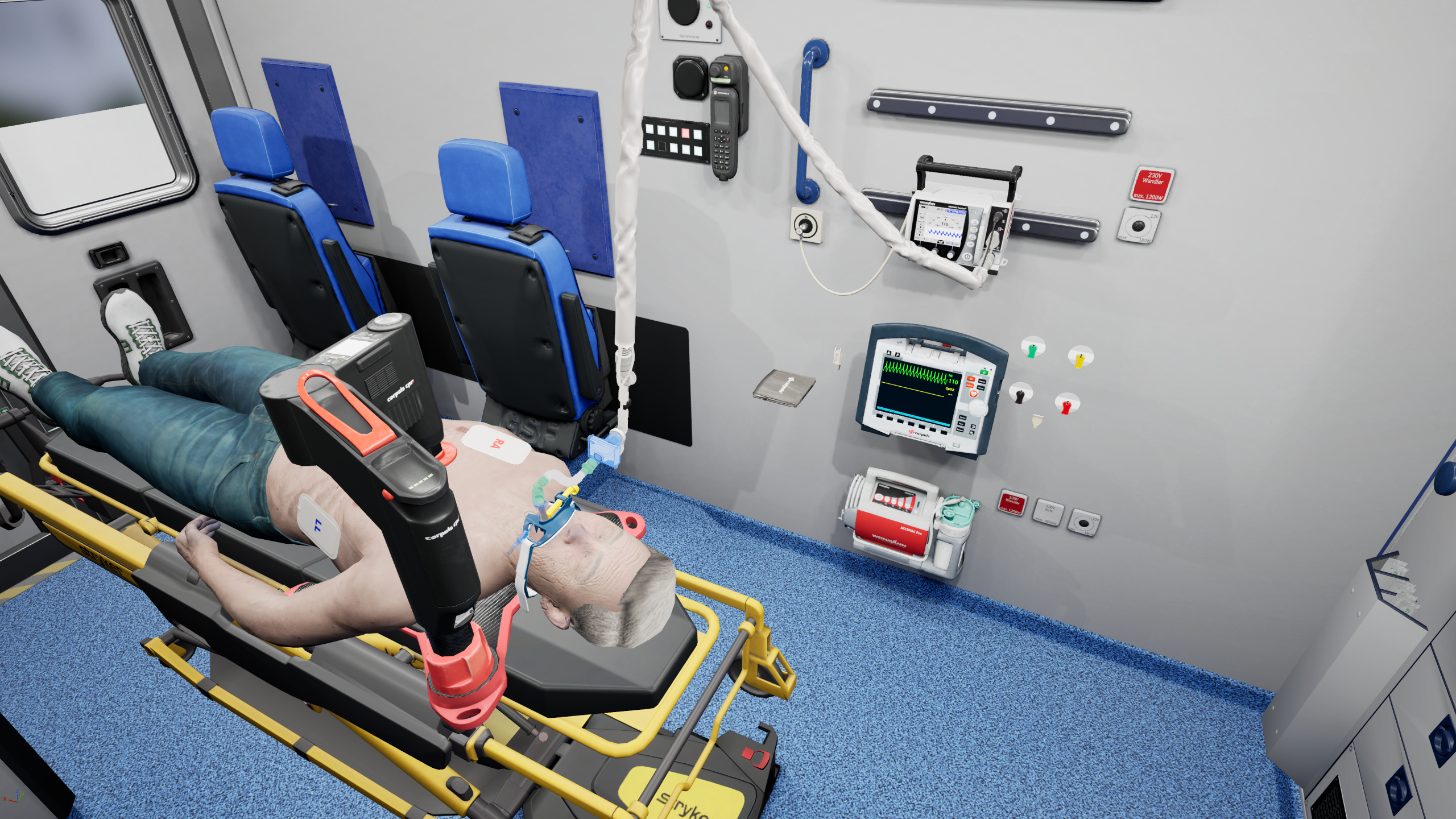
What began as a proof of concept evolved into a significantly more comprehensive training session over the course of the collaboration. The end result was ultimately a fully-fledged DOPES Skill Lab. This is a virtual training program designed to facilitate the structured identification and resolution of acute ventilation problems in intubated patients.
The Skill Lab allows for intensive training in such situations within a realistic-looking environment – such as an ambulance with appropriate ambient sounds. At the start, one or two malfunctions are randomly generated at the push of a button. These can include, for example, disconnected tubes or leaks in the system. The trainees’ task is to identify and correct these errors as quickly as possible. At the end, they receive a report detailing which errors they identified and resolved – and which they did not. Nearly all elements in the Skill Lab can be operated interactively.
As Freericks concludes, “We’re not the only ones excited about the result: Everyone we’ve shown the application to has been impressed. The immersive effect exceeds expectations – even though the well-known limitation regarding haptic feedback in VR remains.”
Since this is a proof of concept, the Skill Lab at WEINMANN has so far been used primarily for internal purposes, such as to liven up training sessions or enhance trade show presentations. However, the positive feedback shows that the VR solution has the potential to bring about lasting change in equipment training at WEINMANN. The company is currently exploring how the concept can be meaningfully expanded and utilized in the long term.