The problem is that training for such large-scale emergencies is complex, expensive, and requires long lead times. As early as 2019, the German Society for Trauma Surgery (DGU) warned of high costs – up to 100,000 euros per exercise in hospitals – coupled with the near-complete shutdown of regular hospital operations. A more recent survey by NDR shows that these figures have barely changed since then.
Additionally, a significant amount of personnel is tied up before, during, and after the exercise. According to a guide from the German Red Cross (DRK, Table p. 37), a full-scale Level IV exercise requires at least 50 people – just for actors, emergency responders, and emergency physicians. Tactical units, other security agencies, and external service providers are not even included in this count. It’s no wonder that such large-scale exercises are often conducted only once or twice a year – if at all – since the resources available to different services and associations vary widely across the country.
VR Simulations Can Help
One possible approach to solving these problems lies in the use of Virtual Reality. The advantages of such systems are manifold:
- Location independence – In the virtual world, even large-scale MCI scenarios can be simulated without requiring much physical space in the real world. With multiplayer functions, spatially separated participants can also take part in a single exercise.
- Customizability – Details and parameters of an exercise can be flexibly adapted with minimal effort, such as the number of injured or the severity of injuries.
- Realism – Virtual Reality can depict large-scale emergencies more realistically than, for example, using mannequins and paper notes. Authentic scenarios and backgrounds can be easily exchanged or adjusted. Animations and soundscapes also represent distractions and stress factors more realistically, while VR still provides a secure environment for users.
- Resource savings – With Virtual Reality, the personnel effort for MCI training is significantly reduced, as instructions and evaluations can be conducted remotely, and there is no need for actors to portray the injured. Consumable materials can also be simulated, reproduced indefinitely, and thus saved.
These advantages can collectively relieve the burden on emergency services, disaster response teams, and other organizations. As a result, significantly more frequent exercises with a large number of participants are possible without compromising the content or quality of the training. Ultimately, this ensures better, faster, and more effective care in real emergencies.
Skill-Labs Are a Good Start
MCI exercises are multifaceted and complex. Therefore, it’s not just the big picture that should be considered. Individual skills on a smaller scale are extremely important, as they form the foundation. For example, triage skills should be prioritized and practiced individually. Whether using PRIOR, mSTaRT, or ESI, different triage algorithms require different criteria and skills that need to be solidified.
For this purpose, a format like the Skill-Lab is ideal, as it allows for intensive and thorough training of these individual skills. Such labs have long been established in medical training and are now also seamlessly possible in VR. This brings not only the general advantages of Skill-Labs but also the VR-specific benefits mentioned above.
VR Training for MCI
Whether it’s an active shooter situation, gas explosion, or train accident – Virtual Reality can simulate MCI exercises with relatively little effort for many participants. Additionally, the technology is excellently suited for training individual and basic skills that are ultimately essential for successfully managing an MCI scenario.
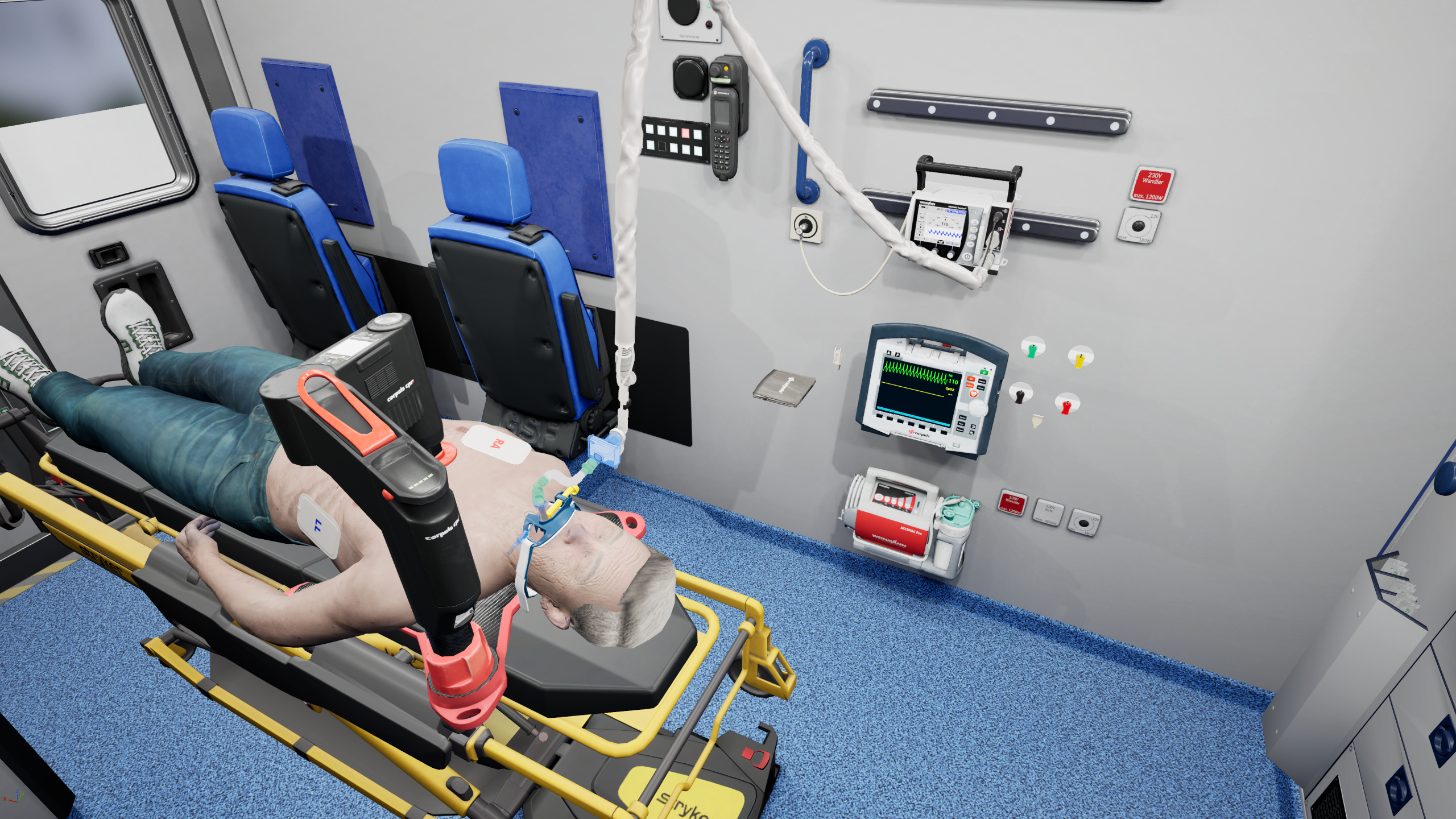
Our high-end emergency simulation, VRescue, currently provides a Skill-Lab with this focus. Here, trainees can intensively practice their triage skills using the PRIOR and mSTaRT algorithms to be prepared for real-life situations.
For the future, a significant expansion of exercises for triage and sorting – also on a larger scale – is planned, as the interest in such virtual training opportunities is high, and the demand is even higher.
Further links
- Announcement of our Skill-Lab for triage training: Skill-Labs are coming to VRescue